Saturday, June 29, 2019

Reading Trap #2: Buttons > Grades

My friend JoAnn suggested I think of the "free" in "free reading" as a verb. YES! Let's free reading from the shackles of grades, quizzes, vocabulary lists, and all those ways we try to justify giving kids time in class to read.

I do not attach a grade to independent (free) reading because
  • I don't want the power and pleasure of reading to be married to grade-grubbing.
  • Each student is at a different point on the avid-reading continuum. How do I grade the kid who reads a book every three days and the kid who finally finished his first book since 6th grade? Both are awesome. The student who is reading-resistant needs my support more than any of them--not a failing grade.
  • I want to minimize opportunities for students to lie to me. If a student isn't liking a book, there is no loss in switching it out for another. 
Some might wonder, if we are not reading for grades, why are we reading? The answers (for pleasure, to be connected to other readers, to personally grow our stamina and knowledge) rise to the top once the grade is removed--and these are motivators that last long beyond the window of the current grading term.

That said, I'm not above using gimmicks to build a reading-happy culture and community in my room. This means celebrating the reading/sharing of books in ways that encourage students to join in.

One of my favorites is buttons.
Two Bee-a-Reader buttons on my lanyard.

I started giving BEE A READER buttons several years ago when my students finished their fifth book. I've since added buttons for the10th, 15th, 20th and 25th book of the year. If they read more than that--and some do!--they have to start over.

Buttons are inexpensive at about 25 cents each, and I love seeing them on my students' book bags. They say "I'm a reader," which is the identity I want them to embrace. I make a deal (not TOO big a deal) when a student earns a button: "Hey guys, Brynna just finished her 15th book!"


I have a buffet of gimmicks, and I'll explain more in future posts. In the meantime, I'd love to hear some of the ways you build reading culture in your classroom and reward reading without grades. Please comment!

Friday, June 21, 2019

Reading Trap #1: Confession Is Good for the Soul


Students in my classes read books of their choosing for the first 10 minutes every day. But making this happen is not as simple as telling kids to find a book and telling them to read. That method will result in a lot of fake-readers, daydreaming or checking their phones. It’s no wonder teachers who try to prioritize reading time give up if students aren’t using it to read.

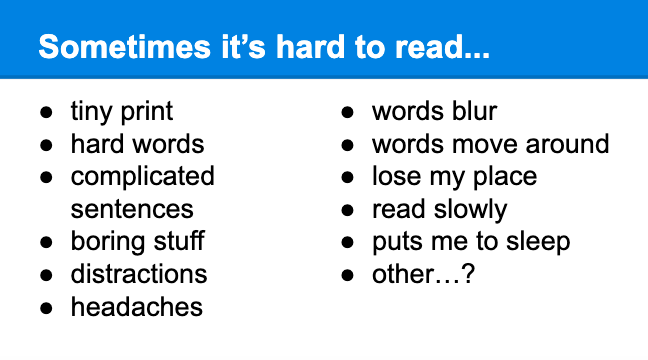
So one of the first things I do with a new class is lay out reasons for building reading stamina. I’ve made a powerpoint that overviews reasons a person should consider becoming a voracious reader. One of the first slides invites students to examine reasons they have struggled reading in some way or another:

Because “tiny print” is the first reason that pops up on the screen, I can tell kids straight off that I don’t like books with tiny print. Given my druthers, I’d read everything in large print. Invariably, a few students agree they, too, don’t like tiny print. And we’re off!

I chime in with my inability to read with concentration if people are talking (distractions) and how especially in the evening, I find myself closing my weak left eye to prevent words from dancing around the page. And I’m not a fast reader. There is almost an excitement in the room as students share the things that have hindered their reading and realize they are not alone.

This communal confession bonds us as a class. We ALL have trouble reading at times, and we’ll work to become readers despite these struggles. This open acknowledgment is a subtle way of keeping the room fake-reading free. We may need a book with larger print, or easier words, or we need to suck on a lemon drop to keep from falling asleep, or switch books because this one is boring, or hold a notecard under a line of print to keep our place. No one is hiding their reading fears in Room #408, and that is the first step to moving forward.

I’d like to know if you can add to my slide of reading struggles. Do you or your students have reading struggles I've missed? Please share!

Next: 
Trap #2: Gimmicks or Grades?

Wednesday, June 19, 2019

Setting Book Traps to Catch Readers

The book that had the most profound influence on my parenting was Mary Leonhardt’s “Parents Who Love Reading Kids Who Don’t.” No longer in print, its thesis is both simple and revolutionary: do whatever it takes to help your child become a reader. Her strategies include what I call "setting book traps": never say no if your kid asks you to buy a book; load up your library card with non-fiction titles of whatever your kids are interested in and prop them in front of the family’s cereal bowls at breakfast; let kids read as late into the night as they want. Read to them. Read with them. Make reading a centerpiece of the home. Leonhardt makes a great case for reading as the single skill that will serve them longest and best through their various life challenges: schooling, loneliness, new passions, understanding of others. As a reader myself, I wanted desperately to raise readers, and I did.

But my passion for turning young people into readers did not stop with my own children. It is the driving force behind the choices I make in my freshman English classroom. If I can get the right book in the hands of a reluctant or indifferent reader, she will experience engagement and emotional connection that she will go looking for again and again. Once she realizes that books deliver that feeling, ta-da! She’s a reader.

A stack currently next to my chair

This transformation is the greatest reward of my teaching. The question “Did I teach them anything?” laces itself through my summer reflections. In truth, we don’t know what our students learned at a depth to last into their adulthoods--or even sophomore year. Our school’s wrestling coach, when asked if he had a good season, said, “Ask me in 10 years when I see what kind of men they’ve become.” I feel that way about my teaching. If my students forget everything I taught them but are readers as adults, I will claim success, because they will know how to pick up a book for knowledge, clarification, pleasure and comfort. They’ll have at their disposal a means to find both answers and questions.

Over the next weeks, I’ll be blogging about strategies I use to push (I’m both sneaky and forceful) kids to read more than they thought they could.

But there are always a few that escape my traps. So as I share my ideas with you, I hope you will share your strategies with me as well. Next year I want to catch them ALL!

Sunday, June 16, 2019

This App Changed My Life

I love a good list. I make one every morning to maximize my productivity, and I usually check off two or three items before I get distracted, lose the list, and fritter the day away.

So I was a sucker for the “Never forget anything again” sales pitch for Due, a list-reminder app for my phone. The fact that it cost $4.99 convinced me it would work better than any of the dozens of free list-making apps out there.

And it has! After spending $5, I figured I’d better watch the video explaining the app’s features to maximize my purchase.


In for a penny, in for a pound. I’d sunk five bucks and watched the video before realizing I still wasn’t sure how to set up my list and would need to commit another 30 minutes into acclimating myself to the gadget.

Which I did. But this means I must now use the app constantly to get my time and money investment back out of it. So I’m using Due for every task of my day, from “crawl out of bed” and “brush your teeth” to “throw the used coffee filter in the trash” and “waddle to the refrigerator and eat a popsicle.” And indeed, each item on my list receives my full attention for the twelve-step process I’ve developed for getting my money’s worth:

Open Due app
Add item to list
Set timer and repeat notification
Set ringtone
Double check time zone
Sync to computer
Tell someone about my app
Check to see if the app did, in fact, remind me of my do-do item
Tweet about it
Do the item on my list
Swipe right
Repeat!

My productivity is skyrocketing.

Saturday, June 15, 2019

Bossy the Cow: What Our Words Say to Girls

I was again reminded of my second-grade report card--a memory I mentioned in a blog post last winter.  The gym teacher had written a word that I couldn’t quite make out. I thought maybe it said I was “busy”--and I hoped that meant I was especially active. I liked P.E!  


My mother translated the teacher’s handwriting and told me the word was “bossy.”


I remember the mortification I felt when I realized my mistake. But last week Missy, a colleague I adore, posted a photo of her fifth-grade report card with the teacher’s comment “disruptive influence in the classroom.” Her post cast my own report-card memory in a harsher light.


Who were these teachers who saw Missy and me--bold little girls--as threats to the order and authority of their classrooms? And are such comments from a bygone era, or are we still demeaning females for behaviors tolerated or even praised in males?


Missy and I have grown up to be productive, leaderful women. But the same traits that serve us well as intrepid spokespeople for quality teaching and justice for all as adults were not seen as positive characteristics in the elementary classroom.


And that got me thinking about the word “bossy,” which I don’t think I’ve ever heard used to describe boys. Women are bossy; men are the boss.


When I dashed the word into my search bar, Google gave me this ever-so-helpful usage example:
"she was bossy, scared of nobody, and full of vinegar"


Note the feminine pronoun in the example.
A subsequent definition for Bossy: a common name for a cow. I’m pretty sure I’ve never heard of a bull named Bossy.

Bossy is a word that underscores the subtle ways language influences our thinking and our thinking influences our language choices. I am choosing to notice my own use of this word and others that make women and girls doubt their value as leaders.

Tuesday, November 27, 2018

What I Remember: Kindergarten - 9

Nov. 26, 2018 Kindergarten: Mrs. Lane - You got married mid-year and brought us wedding cake. Someone brought baby rabbits for show and tell. That is what I remember about kindergarten.
First Grade: Mrs. McCurdy - You sent me to the hall for using a classmate's head as a shelf while reciting the alphabet rhyme: "J is for jar, that sits on the shelf." Chris Vernon had a giant bottle of Elmer's glue.
Second Grade: Sorry. I don't remember you. I do remember the gym teacher writing something on my report card that I thought said "Busy"--a compliment! My mom told me it said "Bossy." I still feel defensive about that trait. I prefer to call it “liking my own ideas.”
Third Grade: First year in Ft. Dodge. Again, dear teacher, I've forgotten you. I do remember my best friend, Janet Windschanz and our fort in the attic of her garage.
Fourth Grade: Mrs. Housman - I loved you--because you liked me. You made us laugh. But I chewed on my pencils, and one day you slapped one out of my hand/mouth and said “Germs! Germs!” like they were visible on the pencil. That moment was rather horrifying, and I remember it. But I still loved you.
Fifth Grade: Mrs. Seymour - You wore a beautiful blue scarf with green polka dots. I cried during parent-teacher conferences as I told you and my mother how incredibly bored I was in your room. Why couldn't we ever have crossword puzzles for spelling instead of just lists of words? Janet Windschanz and I used sign language to communicate across the classroom as a way to dispel the tedium and you wanted it to stop. It was disrupting, obnoxious. Sorry. Sort of.
Sixth Grad: Mrs. Noyes (coolest name ever; No Yes). I remember you were crabby. Was that what you wanted me to remember?
Seventh Grade: My memory strays from my teachers. Instead I remember my mother--recycler before her time--making me reuse my brown paper lunch bag until it nearly fell apart, while others at my table got a new brown sack every day. I remember if you accidentally wore yellow on Wednesday everyone said you were queer.
Eighth Grade: or was it Ninth? Mr. Cass began each Civics class by reciting a quotation that we dutifully wrote in a notebook. Stephanie Fallon and I made a ridiculous movie about Watergate. Mr. D-something taught us geometry. On his birthday someone brought a cake and he found the area, then divided the circumference by the number of students in class to determine how big to make each slice.
And that’s what sticks. Cesare Pavese said, "We don't remember days; we remember moments." Slivers of cake bookend my K-9 experience. Maybe there’s a lesson there.

x

Sunday, November 25, 2018

In Praise of Awkward Practice or Why I Hate Grading

I’ve been grading photo projects, and this makes me think about the aspect of teaching I like least: grading.
If I am teaching in the sweet-spot of learning, my students’ photography (or writing, or
reading, or speaking…) will be messy, awkward, far from perfect.


And that’s good. We need to stumble around in Awkward on our way to Skillful, on our
way to Integrated mastery of new skills.


My mother-in-law and I have been learning to play the accordion for almost two years.
We practice about five times a week. It is joyful learning and I do think we are improving--incrementally.


What would it have felt like to learn the accordion during an Accordion Unit in a
classroom? I suppose there would have been a quiz over what chords matched which
buttons. I would have gotten a C on that (though now, two years later, I’d get an A).


On the first test (“Wait for the Wagon”), my mother-in-law and I could only make it sound
like a song if she played the bass on her instrument and I played the keyboard on mine.
We were thrilled that we could create something that sounded like a song, but had this
been classroom learning, our joint effort would be compared to the student who could
play both hands at once. We might have been given zeros for cheating.


So for two years, we’ve been creating mostly Awkward music that we push into Skillful
and then play at a nursing home. We then select new songs and dive back into Awkward.


If we were striving for A’s, we would only play the songs we already know. (“Wait for the
Wagon” is now fully integrated, by the way.) But real learning--the best, messy, uninhibited
and exuberant  learning--happens in judgement-free arenas.


I love watching my students learn, experimenting with photo composition, caption writing,
camera settings. I try to build lots of Awkward Practice into my teaching, when students
can learn without performance pressure. The photo projects I am grading today are my
students’ evidence of that practice.

And I resent putting grades on that glorious, learningful effort.